A brief overview of Solana, a low-cost network that facilitates innovative methods of online interaction, application development, and value transfer. With Solana, your transaction takes less than a second to complete, however with regular bank transfers it takes days to settle. You may exchange assets without waiting for confirmations or transfer money worldwide as fast as a text message.
What is Solana?
One of the biggest blockchain networks in the cryptosphere, Solana was founded in 2020 by software developer Anatoly Yakovenko and entrepreneur Raj Gokal. One of the top ten cryptocurrencies by market cap right now is SOL, which is its native coin.
The network’s stablecoin relationship with a big credit card processor is just one example of how it has gained widespread notice in the last few years. It has also gained traction as a blockchain for memecoin and NFT initiatives.
Digital transactions may now be fast, safe, and inexpensive thanks to Solana, a high-performance network. From online gaming and payments to digital artwork and finance, it supports a vast array of applications. This article provides an overview of the core features and functionality of Solana.
Getting to Know Solana
Solana is an interconnected system of computers all over the world that can execute apps that anybody can use, process transactions in a fraction of a second, keep prices very low (fractions of a penny), and retain a shared record of all activity. You may think of Solana as the internet for apps and value transfer; it’s constantly on, available from anywhere in the world, and everyone can use it.
How Does Solana Work?
Tower BFT, an acronym for “Byzantine Fault Tolerance,” is Solana’s consensus process. It incorporates elements of the popular proof-of-stake approach. Keep in mind that proof of stake works similarly to a lottery system in that participants are selected at random to confirm each blockchain ledger (staking refers to the voluntary locking of cryptocurrencies in an account that prohibits its use for anything other than holding).
Meanwhile, Tower BFT employs a proof of history timestamp tracking system to generate an immutable record of all transaction information. To validate blockchain transactions more quickly than with either proof of stake or the more conventional proof of work, Solana combines the two approaches.
Performance of Solana
In comparison to Bitcoin’s approx 250 and Ethereum’s 800 transactions per minute, Solana handles an average of over 60,000. With Solana, transaction costs may be as low as a few cents, in contrast to the minimum required by Bitcoin and Ethereum, which are at least fifty cents on average.
Those in favor of Solana stress it’s great efficiency, saying it sets it apart from rivals. Some of its most ardent supporters have even gone so far as to claim it would render Ethereum obsolete. Firedancer, Solana’s second validator client, added resiliency and tested to over 1 million TPS by the end of 2025. Validators gave the go-ahead for the Alpenglow improvement in September 2025, with a finality objective of 100-150ms.
Native Token SOL
The Solana network’s native coin, SOL, is utilized for staking and paying for transactions. Midway through 2026, SOL is still one of the top ten most valuable cryptocurrency projects, thanks to steady attention from developers and increasing backing from institutions. Many countries saw the emergence of spot-SOL ETFs in 2025, and conventional investors poured money into them.
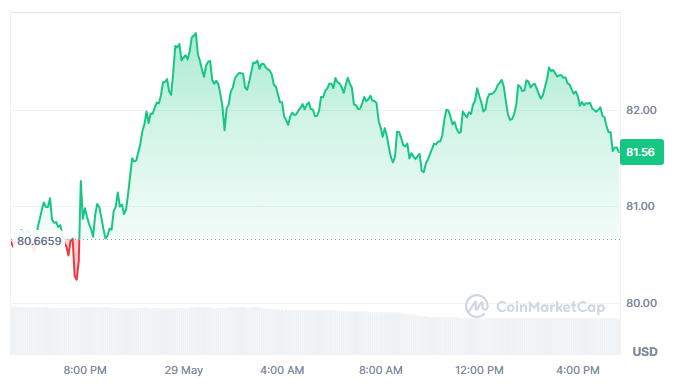
At the time of writing, SOL is trading at $81.42, up 0.11% in the last 24 hours as per data from CMC, with a market cap of $47.17 billion, and 24 hour volume of $3.04 billion.
From a tokenomics perspective, there is no limit to the creation of the SOL cryptocurrency; in contrast, bitcoin has a maximum quantity of 21 million. Inflation is another tool it employs; it determines in advance how much more supply it will produce in order to compensate stakeholders and other network users. The Solana community, which includes investors, validators, core and third-party developers, holders of Solana tokens, and others, has the power to change this timeline by a new proposal.
To counteract inflation, Solana, like many other blockchains with infinite token supplies, has a burning mechanism. This process “burns” cryptocurrency units, taking them out of circulation and reducing the overall quantity. But crypto enthusiasts disagree on whether the system as it is burns enough to combat inflation.
Summary
Solana is considered by many to be among the most promising new blockchain technologies, with the potential to underpin practical applications in areas such as commerce, gambling, and payments. Because it is one of the quickest and most efficient networks, Solana attracts investment due to its performance. In addition to cheap costs, holders may earn SOL by staking, which helps safeguard the network. Additionally, it provides opportunities for developer expansion, since Solana is now the foundation for thousands of projects and applications.
To summarize, Solana is an innovative Proof of Stake (PoS) blockchain that includes many improvements to allow for cheap fees, rapid transactions, and high throughput.