
A decentralized blockchain network and platform for developing software, Ethereum is fueled by the cryptocurrency ether (ETH). Thousands of cryptocurrencies and apps in the fields of decentralized finance, non-fungible tokens, gaming, decentralized social media, and stablecoins call it home.
Launched in July 2015 by software developer Vitalik Buterin and a small band of co-founders, Ethereum is an open, public blockchain. It was a simple notion that became Ethereum. While Bitcoin enables the transfer of digital currency, Ethereum would expand upon this with smart contracts, which are open-source programs.
What are Smart Contracts?
Using smart contracts, anyone may build decentralized applications (dapps) and digital assets that are accessible around the clock and can operate anywhere in the world. Smart contracts are accessible to everybody with an internet connection, unlike banks, businesses, or any other kind of organization. A smart contract is essentially a pre-programmed agreement that is stored on the Ethereum blockchain and executes automatically. Everything is structured according to the if-then logic, thus if action x takes place, then action y follows.
A vast universe of decentralized applications (dapps) for decentralized finance (DeFi), art and collectibles, gaming, and decentralized social media has emerged on Ethereum since its launch in 2015, and the platform itself has blossomed into a prosperous ecosystem of digital assets including governance tokens, stablecoins, and non-fungible tokens (NFTs).
Native Token- Ether (ETH)
“Ether” is the Ethereum token that powers the network. The cryptocurrency that runs on Ethereum is called Ether. While “Ether” refers to the cryptocurrency itself, “Ethereum” refers to the blockchain and protocol that runs it. To make a transaction on the Ethereum blockchain, you’ll need Ether (ETH).
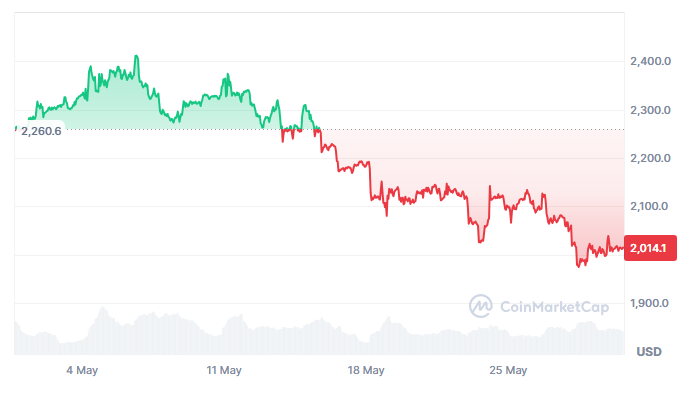
At the time of writing, ETH is trading at $2,013, up 0.74% in the last 24 hours as per data from CMC. Its 24-hour trading volume stands at $13.51 billion and around $243.51 billion market cap.
How Does Ethereum Work?
Similar to other digital currencies, Ether records all transactions on a shared digital ledger. It is easy to access by the public, completely transparent, and difficult to change in the past. In order to secure ‘blocks,’ which are collections of ether transactions, miners must validate them by solving complicated algorithms.
Notable changes occurred in September 2022 when Ethereum switched from a PoW to a PoS framework. The outcome is a decrease in the network’s energy usage of more than 99.99%. A proof-of-work (PoW) mechanism is still used by Bitcoin.
As an extra layer of transaction verification, Proof of Stake (PoS) necessitates that nodes “lock up” a certain amount of crypto via the application of sophisticated algorithms and game theory. Almost no energy is used for this.
Biggest Web3 Ecosystem
One reason Ethereum has the biggest web3 developer ecosystem is because it is composable, much like Legos. This implies that anybody may design new smart contracts by building on top of current ones. Because of this, web3 is powered by hundreds of decentralized applications (dapps).
Every day, millions of individuals utilize Ethereum decentralized applications (dapps) to transact, trade, and hold digital assets. There is no need to provide your personal information, wait for a bank to accept you, or register with your name, unlike with typical applications.
Ethereum Extensions (Layer 2)
To further enhance Ethereum’s capacity, other teams have developed Layer 2 (L2) networks that operate on top of Ethereum. L2s are like express lanes; they speed up transactions and reduce their costs, which may be as low as a penny on average.
Optimism, Arbitrum, ZKSync, and Base are among the most popular L2s that handle millions of transactions annually, with a combined value of billions of dollars.
Conclusion
Ethereum, in a nutshell, is like a massive decentralized computer where users can create any kind of application. There is a common misconception that cryptocurrency is only used for financial services. However, dapps may be developed for any purpose, including games, social networks, voting systems, and more.