Bitcoin is a digital currency that operates independently of a governing body or bank, allowing users to interact directly with one another via the use of blockchain technology.
The Bitcoin (BTC) cryptocurrency was created to serve as a medium of exchange and medium of payment decentralized from any central authority. This does rid of the need for a mint or bank or any other reliable third party to be involved in monetary transactions. Bitcoin is also called the king of cryptocurrencies due to its largest market cap among all cryptocurrencies, dominating the total global crypto market cap by around 57% to 60%.
Satoshi Nakamoto
The person or individuals who first proposed the idea of Bitcoin in a 2008 paper are known by the pseudonym “Satoshi Nakamoto”. The mysterious “Nakamoto” has been missing since 2010, despite his involvement in developing Bitcoin and the blockchain, which helped address the “double-spending” issue. The identity of Nakamoto remains a mystery, and many are curious about him.
In 2008, a mysterious individual or group of individuals known as Satoshi Nakamoto presented Bitcoin to the world. Ever since its launch, it has surpassed all others in terms of size and recognition, and its meteoric rise to prominence has served as an inspiration for a plethora of other digital currencies.
Limited Supply
The supply of government-issued currencies may be endlessly created, whereas the supply of Bitcoin is restricted to a fixed 21 million coins. Depreciation of the currency may occur when governments “print” more money to control the national debt or encourage consumption. Bitcoin is less likely to have its value depreciated by such government acts because of its limited supply, which makes it a deflationary asset that might grow in value as supplies decrease.
“Halving” refers to the method by which the Bitcoin network cuts the supply of bitcoin in half every 210,000 blocks, or about every four years. This decline keeps happening until the final bitcoin is produced, which is estimated to be around the year 2140.
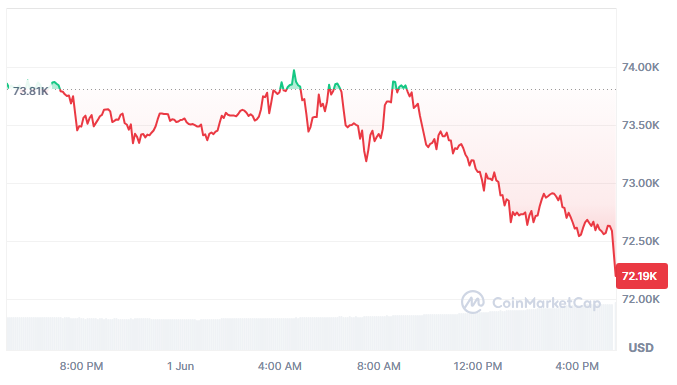
At the time of writing, Bitcoin (BTC) is trading at $72,313, down 2.17% in the last 24 hours as per data from CMC. Its 24 hour trading volume stands at $25.02 billion with a market cap of $1.44 trillion.
How Does Bitcoin Work?
Bitcoin is decentralized and not controlled by any one entity, unlike payment processors like PayPal or credit card networks like Visa. Bitcoin was the first decentralized digital currency that everyone with an internet connection could join. Bitcoin doesn’t rely on private organizations or banks to handle transactions; it was built to be used on the internet.
The blockchain, which imitates a bank’s asset-tracking system, is a crucial component of Bitcoin as it verifies who owns what. In contrast to a bank’s ledger, the Bitcoin blockchain is decentralized, meaning that everyone may access it and no one institution has control over it.
Cryptocurrencies such as Bitcoin use a consensus technique called proof of work (PoW) to verify transactions and ensure the blockchain is secure. Energy usage is considerable because of the large amount of processing power needed to solve encryption challenges during PoW mining. Proof of stake is a less resource-intensive alternative to proof of work that employs staked crypto as collateral.
Storing Bitcoin
You need a bitcoin wallet before you can really own bitcoin. Any computer, smartphone, or other mobile device may download and install a secure bitcoin wallet. You may sign transactions that send bitcoin to other parties using your private key, which is stored in each bitcoin wallet.
Bitcoin Mining
“Mining rigs” are specialized computers that solve the equations needed to validate and log a new transaction. In the beginning, almost anybody with an interest could give mining a go since a regular desktop PC had the processing power to participate. These days, the necessary computers are huge, specialized machines that are often owned by companies or groups of people working together. For example, when Nakamoto mined the initial blocks in January 2009, it took 12 trillion times as much computer power as it does now to create one bitcoin in October 2019.
The integrity of the ever expanding ledger is guaranteed by the combined processing power of the miners. The blockchain is an integral part of Bitcoin; it records all transactions involving current currencies and any new bitcoins that are created. All across the globe, mining rigs compete in a constant lottery on the Bitcoin network to see who can solve a mathematical problem the quickest. Winners are announced every ten minutes or so, and their transactions are added to the Bitcoin ledger.
Conclusion
Sending bitcoins internationally is as simple as transferring them locally. You won’t have to wait three business days for a bank to process your overseas transfer, pay any additional fees, and there are no rules on the minimum or maximum amount you may send.
No one can steal your Bitcoins since they don’t include your credit card details. Similarly to actual currency, there are situations in which it is even feasible to transfer a payment without divulging your identity.
Bitcoin is highly prized by many due to its decentralized and borderless nature. There is a finite quantity of 21,000,000 coins, and it facilitates fast, global payments. Day traders and swing traders, who aim to capitalize on rapid price fluctuations, are drawn to bitcoin because of its volatility.