
The field of energy, chemistry, and drug development are just a few examples of the seemingly intractable issues that quantum computers claim to be able to address. Current, widely-used public-key cryptography protects things like people’s sensitive information, but large-scale cryptographically relevant quantum computers (CRQCs) can also crack it. For a long time, governments and other organizations, have been getting ready to face this security threat.
What is a Quantum Computer?
When it comes to supercomputers, quantum computers (QCs) are basically the way to go. When it comes to processing data and running algorithms, QCs use the rules of quantum mechanics to drastically reduce processing times. This includes methods that can crack traditional decryption. Quantum computers can complete tasks in a matter of seconds or even microseconds, while traditional computers would need hundreds or thousands of years to do the same task. To boost their processing capacity exponentially, QCs employ qubits, which are based on polarized photons (light), rather than traditional bits (zeroes and ones), which enhance a supercomputer’s power linearly.
Quantum Threat Explained
It is possible that quantum computing may find many useful uses. But when thinking about blockchain’s uses and difficulties, the most crucial aspect is cryptography. The potential speed or, more accurately, parallelization, of quantum computers poses a risk to cryptography. They can outperform traditional computers in solving some challenging mathematical problems. A major cybersecurity risk, these challenging mathematical problems are often used as building blocks for cryptographic primitives.
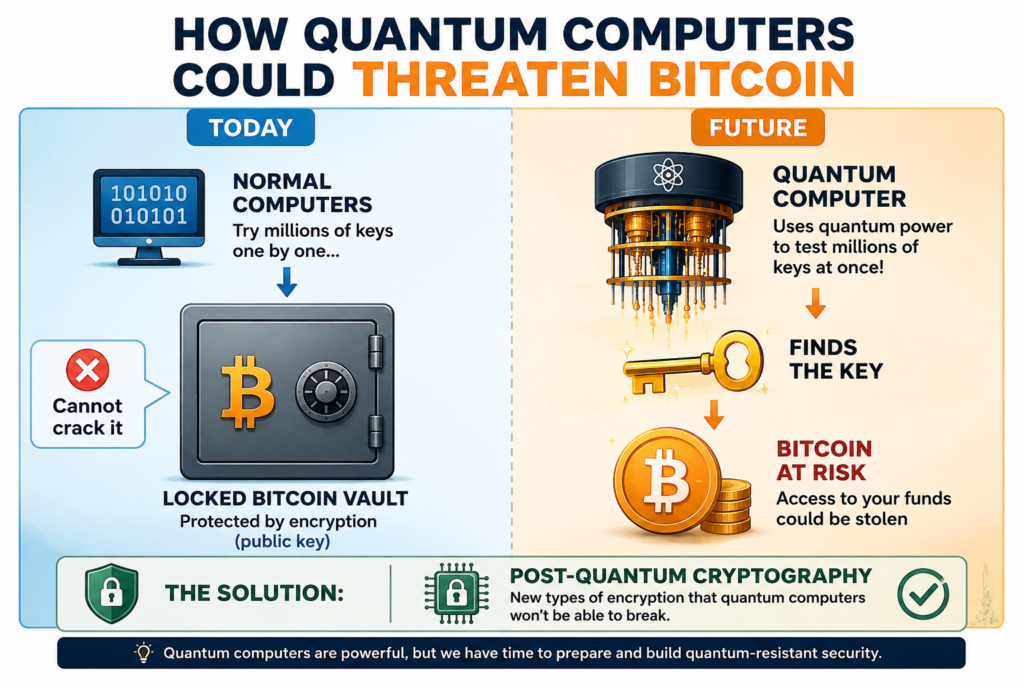
Additionally, the encryption keys used by cryptocurrency might be cracked by quantum computers. Using a public key to decode a private one, for instance, would give malicious actors power over and access to other people’s cryptocurrency. Cryptocurrencies may face danger from quantum computing due to its ability to crack encryption and compromise security.
The 7 Million Bitcoin Exposure
Risks vary by address type and spending history, but according to Coinbase’s quantum advisory council, around 7 million Bitcoin (BTC) are housed in susceptible addresses.
The Pay-to-Public-Key (P2PK) outputs from the Satoshi period are the most susceptible because a quantum computer using Shor’s algorithm may get secret keys straight from public ones on-chain.
Despite the fact that SegWit and Pay-to-Public-Key-Hash (P2PKH) addresses are secure up to the point of transaction, the exposure of public keys while spending makes them vulnerable to swift action by a quantum adversary. Due to the fact that public keys are already on-chain from prior transactions, the danger is increased when addresses are reused. Analytics companies such as Whale Alert are pointing up quantum flaws in UTXO datasets.
The 7 million Bitcoins number encompasses forms with irreversibly exposed public keys, such as P2PK outputs and repeated addresses. It represents around $440 billion worth of assets that a competent quantum computer could steal without compromising conventional private keys.
Recent Move by President Trump
First of two executive orders issued by President Trump on June 22, 2026, the Quantum Computer for Application Development and Discovery Science (QC-ADDS) Effort was initiated by Executive Order 14411.
A state-of-the-art quantum computer is scheduled to be transferred to an energy department facility by 2028, and by December 31, 2031, a cybersecurity directive is expected to be issued mandating a countrywide shift to post-quantum cryptography for digital signatures issued by the federal government.
This is problematic for Bitcoin since, according to Coinbase’s quantum advisory council, there are roughly 7 million BTC, with a value of over $440 billion, stored in addresses that are susceptible to quantum attacks.
Potential Responses to the Quantum Crisis
To strengthen encryption and make it resistant to quantum assaults, researchers are focusing on several avenues:
New cryptographic techniques that can be executed on classical computers but are susceptible to quantum assaults, such as Shor’s or Grover’s algorithm, are being sought after by post-quantum cryptography. They stem from intractable mathematical issues, distinct from prime or elliptic curve factorizations, which not even quantum computers have the ability to resolve.
New cryptographic protocols are the backbone of quantum cryptography, and they can only be developed and performed by computers with quantum capabilities.
Whether we’re talking about post-quantum or quantum protocols, the process of developing and standardizing new cryptographic primitives is arduous and time-consuming, and it always involves the world’s leading cryptographers. The National Institute of Standards and Technology (NIST) established a standardization challenge to hasten the development of stable and practical post-quantum algorithms. Over the course of several rounds, a number of post-quantum algorithms have been vying for the title of future standard in post-quantum cryptography.
What Investors Need to Know?
It should be remembered that quantum computing is still in its infancy, despite the possible consequences. Environmental factors, such as the Earth’s magnetic field, nearby radiation, and cosmic rays, may readily influence modern quantum computers. This means that present-day quantum computers are likely to make mistakes in their computations.
Quantum computers are still only available to a select group of businesses and academics due to these practical and technological hurdles. Quantum computers may likely not affect existing cryptography techniques for at least another decade.
The field is always evolving, therefore it’s vital to keep an eye on the possible effects of quantum computing on cryptocurrencies. In order to combat the possible dangers of quantum computing, developers and entrepreneurs are investigating new encryption methods and advancements. Another potential outcome is the creation of cryptocurrency that is impervious to quantum computing.