
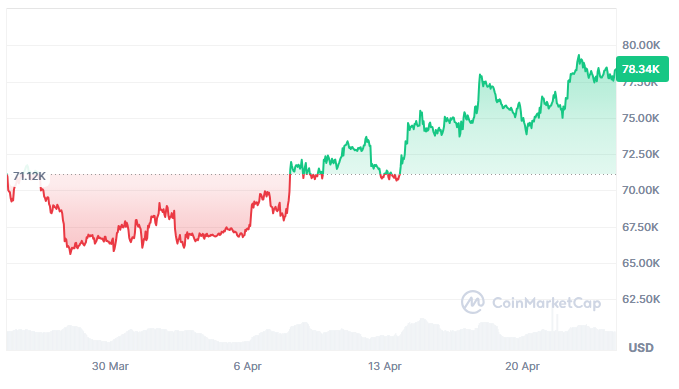
Bitcoin has been trading in a narrow range between $77,500 and $78,500 since midnight UTC on Friday, as volatility in the cryptocurrency market eased. Although the larger trend is still positive—with the BTC price grinding up through April and printing a succession of higher highs and lower lows—the market action is still modest, after a failed breakout attempt around $80,000 on Wednesday.
Similar to bitcoin’s behavior on Friday, Ether (ETH) has been trading in a confined range and has lost around 0.9% since midnight. Despite solid tech results, U.S. stock futures for the Nasdaq 100 rose 0.5% while the S&P 500 fell 3 basis points.
Despite remarks from U.S. President Donald Trump announcing the three-week extension of the truce between Israel and Lebanon, the Dollar Index (DXY) remained mostly unchanged. When the truce was first proclaimed on April 16, the dollar declined by around 0.5%.
Bullish Momentum About to Settle Down
Following earlier this week’s failure to breach $80,000, the increase in spot price has pulled back to $77,500, causing a 6% decrease in Bitcoin futures open interest to 744.3K BTC in 24 hours. The market participants are reducing their leveraged holdings, which indicates that the bullish momentum is about to settle down.
As a result of more sellers hitting the bid than buyers increasing the ask throughout the timeframe, the 24-hour open interest-adjusted cumulative volume delta for Bitcoin has become negative. The persistence of somewhat negative annualized permanent funding rates is indicative of the preponderance of short bearish bets.
When bitcoin’s price surpassed $78,000, Michael Saylor said, “winter is over” for the cryptocurrency. However, not all observers agreed that the current decline constituted a complete crypto winter. According to market researcher Mati Greenspan, bitcoin has likely already hit bottom and is ready to go higher, and the current downturn is only a pullback in a larger bull market.